
A Practical ATMA Preparation Plan: Section-Wise Study Strategy and Time Management
Introduction
Preparing for ATMA is less about finding the perfect timetable and more about following a routine you can sustain. The exam tests analytical reasoning, quantitative ability and verbal skills. To improve, identify where you are losing marks and give those areas focused attention. A practical ATMA preparation strategy starts with understanding your own strengths and gaps.
A sound preparation strategy has three parts: a diagnostic test, section-specific practice and regular timed tests. You do not need to spend the same amount of time on every topic. Focus on improving accuracy while maintaining speed and avoiding fatigue and careless errors. These principles form the foundation of an effective ATMA preparation strategy.
Before setting your schedule, check the latest exam instructions and syllabus. Details can change, so use official information to confirm the number of sections, question rules and total time. Build your ATMA preparation strategy around the current exam format rather than outdated assumptions.
Analysing the sections
Each skill area calls for a different approach. Analytical reasoning rewards pattern recognition and careful elimination. Quantitative questions require sound methods and efficient calculation. Verbal questions test comprehension, precision and the ability to distinguish supported answers from plausible ones. A balanced ATMA preparation strategy accounts for the different demands of each section.
Start with a timed diagnostic set for each area. Record your score and the reason for every mistake: a concept gap, a misread question, a calculation error, an unsupported inference or time pressure. Identifying the cause matters; repeating questions will not fix a misunderstanding. Use these results to shape your ATMA preparation strategy from the outset.
Use your results to build a section-wise ATMA study plan. If weak fundamentals are holding you back, focus on learning and untimed drills. If you score well without a timer but struggle under time pressure, work on pacing, question selection or anxiety. Give the greatest attention to the area with the clearest potential for improvement, while continuing to practise the other two. This makes your ATMA preparation strategy specific to your needs.
Analytical reasoning
For analytical reasoning practice, focus on organising information. In arrangement, sequence and relationship problems, write down the conditions before considering the answer choices. A simple diagram or table can help you avoid rechecking the same condition. Include this structured approach in your ATMA preparation strategy.
Practise in short sets and review your reasoning step by step. Did you miss a condition, make an unsupported assumption or spend too long on an unproductive approach? Once your accuracy improves, add a timer and practise moving on when a problem stops making progress.
Quantitative skills
Begin quantitative skills preparation with a topic review. Identify what you can solve reliably, where you need to revise formulas and which concepts remain difficult. Strengthen the basics before attempting large sets of mixed questions; speed without a reliable method often leads to mistakes. A sound ATMA preparation strategy builds accuracy before prioritising speed.
Keep a concise error log. For each wrong answer or guess, note the concept, the step that went wrong and the correction. Return to the question later, when the original solution is no longer fresh. A successful second attempt will then tell you more.
Verbal skills
Verbal skills practice is more effective when it is consistent than when it is crammed into occasional long sessions. Read a short passage or editorial each day, then summarise its main claim, evidence and tone. This helps you follow the author’s argument and distinguish what the text says from what you expect it to say. Make regular reading part of your ATMA preparation strategy.
For grammar, vocabulary and sentence-based questions, look for patterns in your mistakes. Instead of collecting unfamiliar words without context, note each word’s meaning in the passage and its role in the sentence. For comprehension questions, check the text before choosing an answer that sounds plausible but lacks direct support.
Key factors
The first key factor is deliberate review. A mock test is useful only if it shapes your next steps. Sort mistakes by type and section, then choose a few recurring problems to address the following week. A review that leads to no change is just a report, not a training plan. Regular review keeps your ATMA preparation strategy responsive to your progress.
The second is realistic pacing. ATMA time management starts before exam day. Practise deciding when to solve, skip or return to a question. Use the current exam format to set time targets, then test them in full-length mocks. A pace that works in short drills may not hold under pressure. Include pacing practice in your ATMA preparation strategy.
A target time does not mean you should guess blindly. If a question is taking too long, mark it if the exam rules allow, move on and save time for questions you can answer. A planned skip is a decision; an unplanned struggle costs time.
The third factor is balance. Focusing every session on your weakest area may seem productive, but the others can become rusty. A practical week might include three focused sessions for your priority section, two shorter sessions for the other areas, one mixed timed set and one review block. Adjust this schedule to your available time and diagnostic results.
Build recovery into your schedule, too. Short sessions with clear goals are easier to sustain than vague, all-day study. Protect your sleep, take breaks and avoid trying a new strategy in the final days. Use that time to reinforce familiar methods.
Match scenario: turning preparation into performance
Imagine a candidate with four weeks to prepare and around two hours to study on most days. In the first few days, they complete diagnostic sets, check the latest exam details and start an error log. The rest of the first week focuses on core concepts, with some timed practice to build accuracy before speed. This is a manageable way to put an ATMA preparation strategy into action.
In weeks two and three, the candidate adds more mixed sets and regular mock exams. After each mock, they review which questions they missed because of weak knowledge, poor selection or careless execution. They use those findings to plan the next few days instead of following a fixed schedule that ignores their results.
In the final week, the focus shifts to revision. The candidate reviews recurring mistakes, practises familiar question types under realistic conditions and keeps sessions short enough to stay focused. On exam day, they follow the pacing approach tested in mocks, read the instructions carefully and avoid letting one difficult question disrupt the rest of the paper.
Conclusion
An effective ATMA preparation strategy is about making better decisions, not simply spending more hours at a desk. Identify your gaps, practise each section according to its demands, review mistakes and test your pacing under timed conditions.
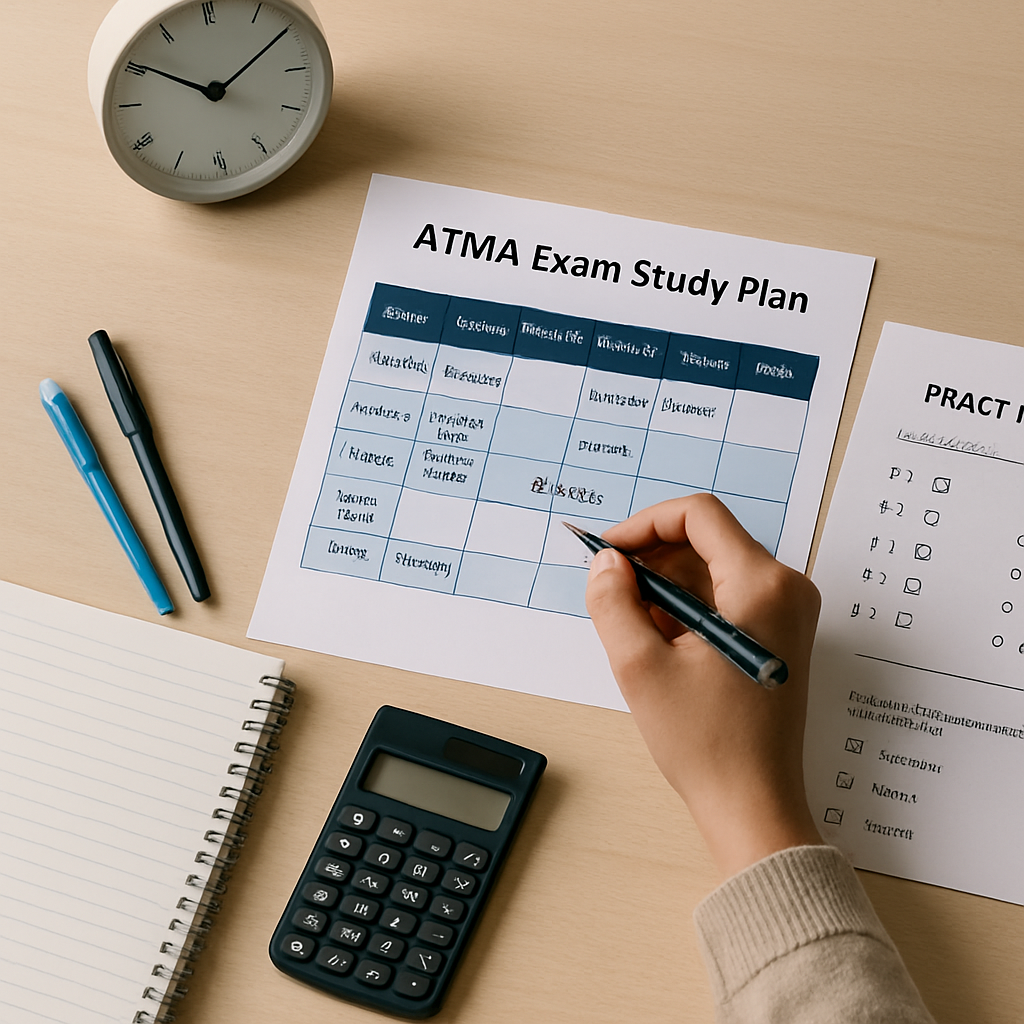
Consistency is what makes the plan work. When every session has a purpose and every mock leads to a specific adjustment, preparation becomes more controlled and performance less dependent on guesswork.