
Introduction
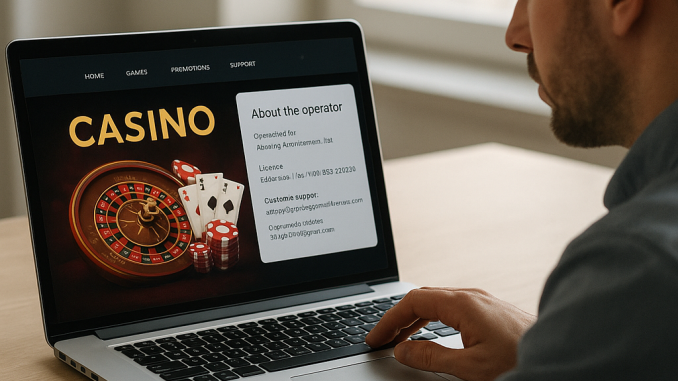
A casino website may look like one polished operation, complete with a name, logo, cashier and support window. Behind the interface, however, several companies may handle different parts of the service. Customers do not need every corporate detail on the homepage, but they should be able to identify the business responsible for deposits, complaints and games.
A brand is not necessarily the operator. One company may own the name while another holds the relevant licence, processes payments or provides the platform. If these roles are unclear, customers may not know who is responsible when a problem arises.
Good disclosure is neither a dense corporate dossier nor a vague line of small print. It clearly identifies the business behind the website and explains the relationship between the brand, operator and licence.
Analysis of the sides in play
Think of the website as a team sheet. The brand is the name on the shirt; the operator is the side taking the field: the legal entity that runs the service and, where applicable, is authorised to offer it. Customers should not have to work out who that is from a payment descriptor or footer.
Other companies may play important roles without being the operator. A platform provider may host the site, a payment company may process transactions, game studios may supply products, and an affiliate may refer customers. Listing every supplier is not necessarily helpful. What matters is distinguishing these supporting parties from the company responsible for running the service and dealing with customers.
That distinction should be explained in plain language. If one company owns the brand and another operates the casino, the site should say so and clarify which entity handles accounts, deposits, withdrawals and complaints. A list of company names without those connections may be detailed, but it is not clear.
Licence information is important, but it does not replace the operator’s name. Customers should be able to see which entity is licensed, the relevant jurisdiction and, where applicable, the scope of the authorisation. A licence should not be presented as an endorsement of every aspect of the business, nor should the operator’s identity be obscured by references to a regulator.
Key factors
Start with identity. Publish the operating company’s full legal name, registered address and a reliable way to contact it. If the brand, contracting party and licensed entity are different, explain how they relate. Customers should be able to answer one basic question without legal training: which company am I dealing with?
Be specific about accountability. Explain which entity handles accounts, payments and complaints, and which company is bound by the customer terms. If responsibilities are divided, make that clear. “We work with trusted partners” is no help when a withdrawal is delayed or a complaint needs to be escalated.
Give context for locations and licences. A registered office, operating address and licensing jurisdiction may all differ. Label each accurately rather than letting one address stand in for the others. Keep licence information current, tie it to the named company and briefly explain what the authorisation covers.
Make disclosures easy to find. Place the information in predictable locations, such as the terms, a legal or company-information page, and the account or cashier journey where customers need it. Repeating the full corporate structure on every screen would create clutter; hiding it behind several layers of navigation would make it hard to use.
Keep information up to date. Corporate arrangements change: an operator may be replaced, a licence may change status or payment responsibilities may move. Disclosures should reflect the live service and explain material changes. An outdated page is not transparency; it is an old team sheet presented as current.
There are limits to what needs to be published. Beneficial ownership details, directors’ names or extensive corporate records may be required by law or relevant to public accountability, but more information is not always better. Personal details that do not help customers identify the operator or make a complaint can create privacy and security risks. The standard should be relevance, not maximum disclosure.
The match scenario
Consider a customer whose withdrawal is delayed. They need to know which company manages their account, who is processing the payment and where to send a complaint. If the website identifies the operator and explains the payment provider’s role, the customer has a clear route to resolve the issue.
Now imagine the customer sees one name on the website, another in the terms and a third on the transaction record, with no explanation of how they fit together. Support replies vaguely, and the customer cannot tell whether the problem belongs with the operator or a contractor. The delayed payment is the immediate issue; the deeper problem is that the site has made accountability unclear.
Disclosure should be judged by how well it works when something goes wrong, not by how many company names appear on a page. Customers may never read the legal section until they have a problem. At that point, the site should provide a clear chain of responsibility rather than rely on its apparent simplicity.
Good disclosure cannot guarantee a quick resolution, an error-free service or a favourable outcome. It can make clear who must respond, what role other businesses play and which formal complaint route applies. That is a modest but meaningful commitment.
Conclusion
A casino should provide enough information for customers to identify the legal operator, understand its relationship to the brand, check the relevant licence and find the right route for account or payment disputes. It should explain how responsibilities are divided without turning a customer-facing page into a corporate filing cabinet.

The test is simple: could someone unfamiliar with the business tell which company runs the website and who is accountable for the service? If not, the disclosure is incomplete, however polished the brand may look. Transparency does not prove trustworthiness; it gives customers the basic information they need to see where responsibility lies.